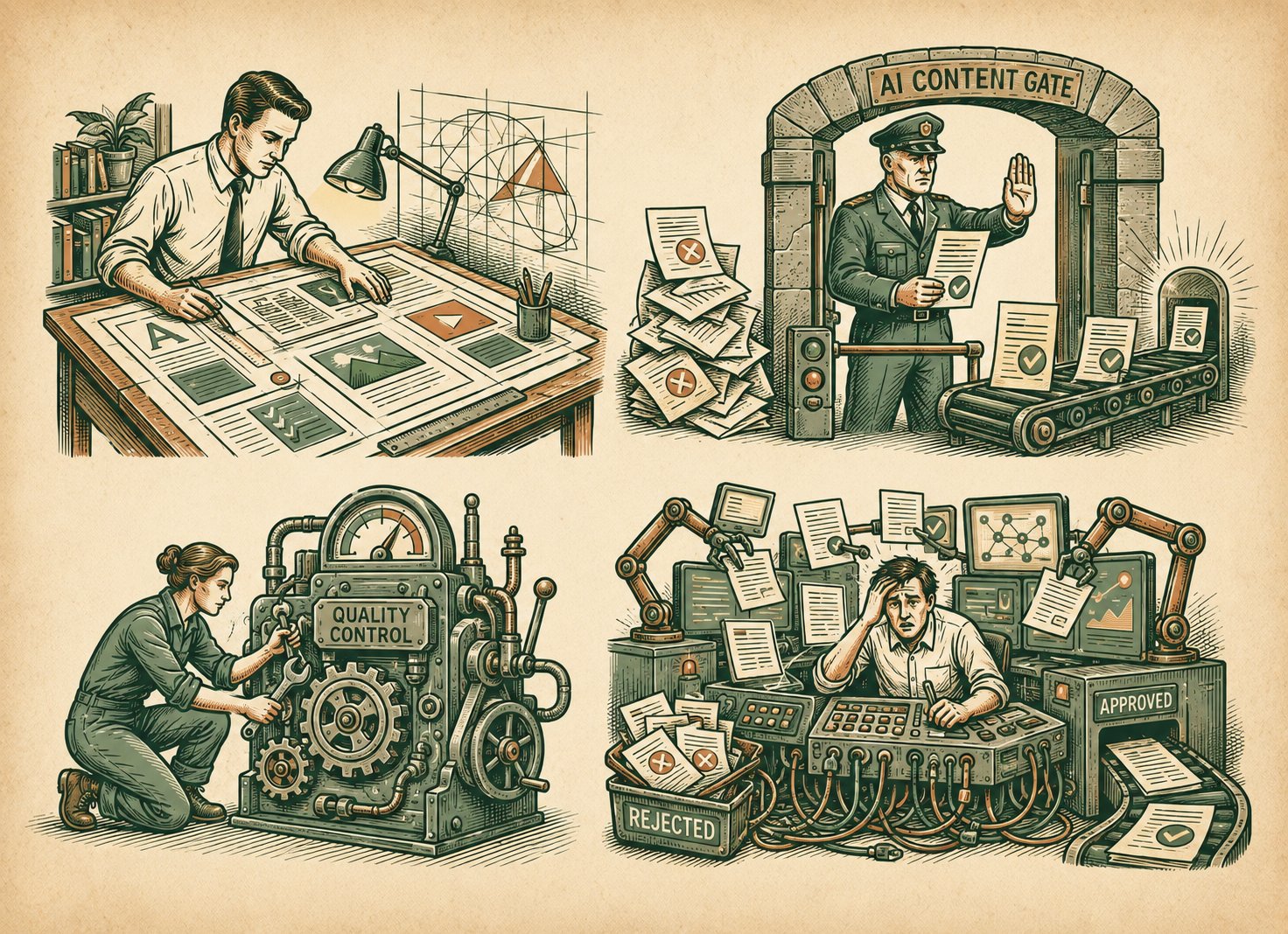
"It reads fine."
That is the bar most teams are using right now. Read it through, nothing obviously wrong, hit publish. Move on to the next one.
That bar is why your content has stopped working.
The problem is not that your team is using AI. Everyone is using AI. The problem is that "reads fine" is the lowest possible threshold a piece of writing can clear, and it is the exact threshold a language model is engineered to hit. ChatGPT was trained to produce text that sounds plausible. Plausibility is its specialty. If your only filter is "does this sound okay," you have outsourced your editorial judgment to the same machine that wrote the draft.
You need actual guardrails. Not vibes. Not "use AI thoughtfully." A real checklist your team runs before anything ships under your name.
Here is the one we use.
THE REAL DANGER IS NOT BAD GRAMMAR
Most content teams I talk to think the danger of AI writing is bad grammar or factual errors. So they hire an editor to fix the grammar, fact-check the claims, and call it done.
That is not the danger.
The danger is the opposite. AI writes content that is grammatically perfect, structurally tidy, factually defensible, and completely interchangeable with what your competitor down the street is publishing this week. It is autocomplete with a profile picture. It sounds like a person. It says what every other person with the same prompt would say.
Flawless LinkedIn posts are the new fake. Flawless blog articles are the new fake. The audience can feel it even when they cannot name it. And so can the AI systems you are trying to get cited by, which are increasingly weighting distinctiveness over polish.
Polish is not the goal. Distinctiveness is the goal. Your guardrails have to be calibrated for that, not for "no typos."
GUARDRAIL 1: DOES IT NAME A SPECIFIC BELIEF?
Open the piece. Read the first two sentences.
If the opening describes a topic ("AI is changing how businesses get discovered online"), reject it. If the opening names a belief somebody actually holds and signals it is about to be dismantled ("Most owners think SEO is dying. It is not. It is mutating into something they are not ready for"), keep reading.
This is the single fastest filter. AI defaults to explanatory mode because explanation is the average of all the training data it was fed. Humans with a point of view do not open by explaining. They open by arguing. If your draft opens like a Wikipedia entry, the AI wrote it and did not bother to read the room.
GUARDRAIL 2: IS THERE A METAPHOR A READER CAN SEE?
Scan for sensory language. Specific, picturable images that translate the abstract into something the reader can hold in their head.
AI writing is allergic to specificity. It produces "leverage synergies" and "navigate the landscape" and "harness the power of." It avoids concrete imagery because concrete imagery requires a point of view, and points of view are statistically risky in the training distribution.
A real writer writes "ghost town with a login screen" or "redecorating the kitchen while the chef moved to a different restaurant" or "smart toaster pretending to be a chef." A reader sees those. A reader feels those.
GUARDRAIL 3: DOES IT SOUND LIKE THE PERSON WHOSE NAME IS ON IT?
This is the one most teams skip because it is the hardest to measure.
Every writer has a thumbprint. The asides they use. The rhythms they default to. The mocked behaviors they return to. The metaphors they reach for. When you read enough of their work, you can hear them in your head.
AI writing has no thumbprint. It has the average thumbprint of every writer in its training data, which is the same as no thumbprint. So the piece you are about to publish under your name might be grammatically clean and factually correct and read perfectly fine, but it sounds like nobody. Which means it sounds like everybody. Which means the reader has no reason to remember it came from you.
GUARDRAIL 4: DOES IT HAVE A TAKE, OR IS IT A SURVEY OF TAKES?
AI writing hedges. It tells you both sides. It says "while some argue X, others argue Y, and the truth likely lies somewhere in between." Every claim comes pre-softened.
Hedging is the statistical safe path through any contested topic. The model was trained to avoid offending the maximum number of training examples, which means it was trained to never commit to anything.
Your content's job is to commit.
If the piece on your desk surveys the conversation instead of joining it, reject it. Pick a side. Name what you think is wrong with the other side. Defend the position. A reader does not need another summary of what everyone is saying. A reader needs to know what you are saying.
GUARDRAIL 5: DOES IT CLOSE WITH SOMETHING ONLY THIS WRITER WOULD SAY?
The end of an AI draft is where the fake shows hardest. It defaults to "in conclusion" energy. It restates the argument. It encourages the reader to "embark on their journey." It thanks them for reading.
A human writer with a point of view closes with something that lands like a thumbprint. A challenge. A permission slip. A line that only makes sense if you have followed the argument. A sentence the reader will quote back to you a month later because it stuck.
WHEN THE GUARDRAILS CATCH SOMETHING
Most of the time, a draft that fails one guardrail fails three. The opening explains, the body hedges, the close is generic. That is not a draft you fix. That is a draft you scrap and restart from a sharper input.
Here is the rule I give every writer on my team. If you have to use AI to draft, use it on something you have already thought about. Not as a thinking replacement. As a typing replacement. The take has to come from you. The structure has to come from you. The point of view has to come from you. The AI fills in the words faster than your fingers can. That is its job. The job it is not allowed to do is decide what the piece is about.
If the AI is deciding what the piece is about, you have handed it the editorial. You have outsourced your voice to a system that has no voice. The output will be exactly what you would expect: smooth, plausible, forgettable.
THE COST OF SKIPPING THIS
I know what you are thinking. "This is going to slow us down."
It will. That is the point.
The content economy is now flooded with AI drafts produced at a speed no human writer could ever match. The competitive advantage is not volume anymore. Anyone can produce volume. Volume is free. Volume is the new minimum.
The competitive advantage is distinctiveness. Pieces with a real point of view. Pieces a specific human would write and a specific reader would remember. Pieces that show up in AI Overviews and ChatGPT answers because they are the only ones in the training data that committed to a position.
If your guardrails let through twelve generic drafts a week, you are flooding your own channel with the same noise everyone else is flooding theirs with. You are invisible by participation. You are paying to add to the smudge.
If your guardrails ship three pieces a week that pass all five, you are publishing less and getting cited more. Because the AI systems making recommendations are starting to weight what your audience already weights: who actually sounds like somebody. That is the same lesson the Business Visibility Index findings keep pointing to. Distinctiveness compounds. Sameness disappears.
THE CLOSE
The guardrails are not there to make AI useless. They are there to make sure AI does not make you useless.
A language model can produce a draft faster than any writer. It cannot produce a point of view. It cannot produce a thumbprint. It cannot produce the specific human voice that makes a reader stop scrolling and a citation engine attribute expertise to a name.
That part is still yours. You can choose to keep it or you can choose to give it away.
If a machine could have written it and nobody would notice, the machine already won.
Run the guardrails.
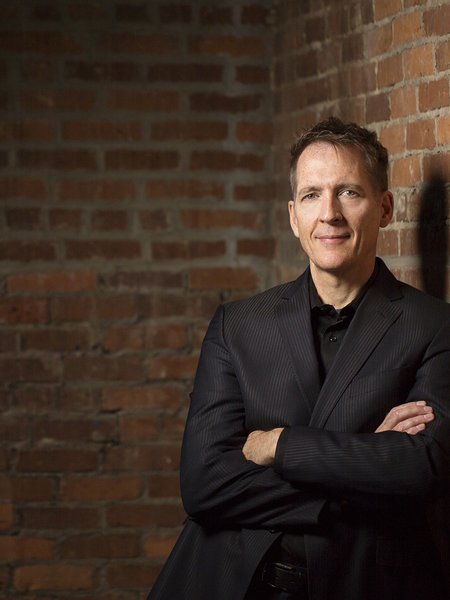
Forbes contributor. TEDx speaker. VP of Brand Communication at Thrive Internet Marketing Agency. Creator of the Business Visibility Index. Author of UNINVISIBLE. Former professional magician with 25 years on stage including the MGM Grand. Full bio →
GET THE BVI REPORT
The full Business Visibility Index research. 400 companies. 5 industries. 2,400 AI queries. Download the report that started the conversation.
Download the Free Report →WATCH THE THUMBODY® SHOW
New episodes weekly on authority building, AI visibility, and the frameworks from UNINVISIBLE™. No fluff. Just the work.
Watch the Show →UNINVISIBLE™: THE BOOK
The playbook for business owners who are done being invisible. Research, frameworks, and the 99-day plan.
Learn More →